The 19.0 / Winter 2026 update was released on February 9, 2026.
Salesforce managed package access
Temporarily, the standard access to the package via Salesforce AppExchange marketplace does not work. Use this link instead (link updated for Winter 2026 Update4 / release 19.0.6).
"Arg_KeyNotFoundWithKey" calendar problem
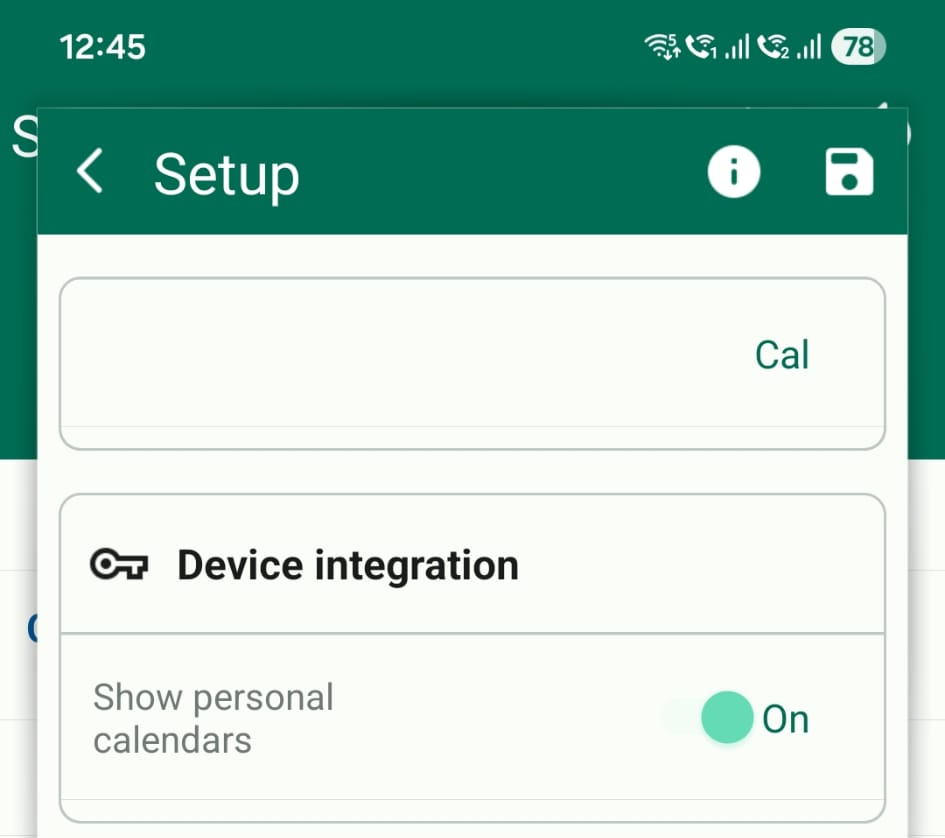
Accessing the calendar may display the error Arg_KeyNotFoundWithKey, resco_personalappointment.
-
As a workaround, go to the app setup and set Show personal calendars to "Off".
-
To solve the problem, update to the latest version of the app (19.0.1 or later).
Modernized questionnaires
The Questionnaire Player has been completely reworked and modernized using React-based technology and the MUI design framework. It delivers a fresh, modern user interface with a consistent layout and responsive design that adapts seamlessly across desktop, tablet, and mobile devices. The Questionnaire Player is no longer dependent on Woodford. Data collection is now possible outside Resco Mobile CRM without a mobile project or any Woodford-specific configuration. Questionnaires are defined once and can be rendered consistently in Resco mobile apps, Power Apps, Power Pages, and Dynamics 365, without changes to the form itself. Behind the scenes, the original proprietary implementation built on legacy components has been fully replaced by a modern architecture designed to support ongoing enhancements and future requirements.
See Modernized Questionnaire Player for details.
AI voice-activated form filling
You can now use conversational AI to fill out questionnaires. Technicians can now initiate a guided voice session where the AI assistant "reads" the questionnaire aloud, following the logical order of question groups. The system is fully rule-aware, meaning it respects existing skip logic and asks only relevant questions based on previous answers. The interaction is flexible: users can choose to answer questions one by one or summarize an entire group of questions in a single spoken prompt. All transcriptions are displayed in real time and remain editable, allowing a final human review before the form is saved.
This use case requires you to set up an OpenAI API key in Woodford configuration. It is only available in the new questionnaire player in Resco Mobile CRM and requires an internet connection for the AI conversation.
Enhanced integration with Power Pages
We've fundamentally reimagined how our technology integrates with Power Pages. Questionnaire Player now operates as a native, lightweight React component that loads directly in the browser without heavy background processes and with a streamlined data model. To get you started faster, we've included a preconfigured "Demo Page" that lets you deploy a working example almost instantly.
AI translate for questionnaires
Utilize the power of AI to quickly generate localized versions of your questionnaires. Edit a questionnaire, click Change Localization, add any language, then click AI Translate.
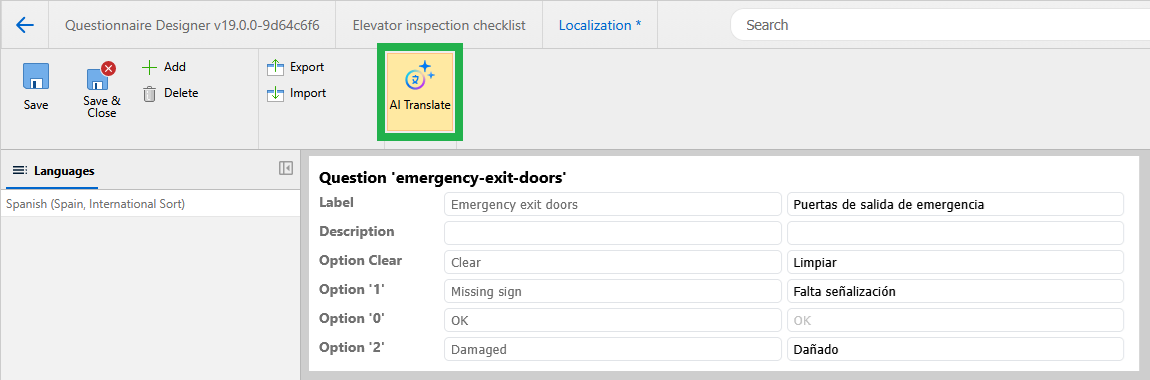
(This feature was added in release 18.2.2, i.e., after the previous full release, that's why we're mentioning it again to make sure you don't miss it.)
Table of contents
Questionnaires now include an automatically generated table of contents. No more endless scrolling when you can jump straight to the relevant section. If you are using group scoring, the TOC displays real-time scores for each section as they are completed, giving users immediate feedback on their progress.
Rich text
In the past, if you wanted to guide a user, you had to juggle separate blocks for text, images, and links. Rich text combines everything into a single formatted block. The intuitive editor supports bolding, bullet points, hyperlinks, and embedded images. Build professional-looking miniguides right inside the form.
Search button
Find what you are searching for without scrolling. Navigating large questionnaires is now much more effective thanks to the Search function.
Improved validation
Mistakes happen, but users should not be punished for skipping a question. Validation now highlights missing/invalid answers and guides the user from question to question until all problems are solved.
Better integration with Power Apps
We have deeply embedded the modernized questionnaire player into the Power Apps ecosystem by transforming it into a native PCF (Power Apps Control Framework) component. The player is now "context-aware"; it can often infer the correct template from the form context, or display a native lookup dialog for immediate selection. The player can automatically link itself to parent records—like Assets or Accounts—by passing "Regarding" information directly through the form parameters, ensuring every entry is perfectly categorized.
QPBridge
QPBridge is a modern, TypeScript-based library designed for the next generation of questionnaires. Unlike the legacy callback-based system, QPBridge supports asynchronous functions and is strongly typed, making it significantly easier for developers to write, debug, and maintain complex logic.
Deprecated features and compatibility
The following features are no longer available or greatly transformed in the modernized questionnaire player:
-
Simplified styling: We are moving away from complex, global "Styles." These have been replaced by intuitive color settings and layout options (such as horizontal or vertical orientation) that are now configured directly within individual question properties.
-
Standardized data formats: To ensure maximum speed and reliability, legacy data formats are no longer supported. The modernized player now exclusively utilizes full template dependency, our latest JSON schema, and the questionnaire_answer entity for all response storage.
-
Legacy static components like logo, static image, description, link, etc., have all been combined into rich text.
We understand that some existing workflows may rely on these specific legacy components. If your current operations require these features, you can continue to use the legacy Questionnaire Player (Gen 1) alongside the new version until you are ready to transition your templates to the new standards.
Whitelist new Resco web services
We are now going forward with the change announced one year ago. The fully qualified domain name (FQDN) of the Resco license server is changing from iservices.resco.net to svc.resco.net. If you are using a firewall to block outgoing communication, you need to add the new FQDN to its whitelist:
-
svc.resco.net -
svc-01.resco.net -
svc-02.resco.net
The current FQDN iservices.resco.net remains active for some time to help you with the transition.
IP addresses
Some network infrastructure can require IP addresses rather than domain names. The IP addresses are managed by Microsoft Azure and may change over time. You can download them from Microsoft: https://www.microsoft.com/en-us/download/details.aspx?id=56519
Alternatively, you can download the list of FQDNs and IP addresses from Resco in JSON format. This download also includes the IP addresses for outbound communication. It is cached and updated every 4 hours.
-
https://svc-dev.resco.net/network/allowlist (temporary list)
-
https://svc.resco.net/network/allowlist (future permanent list)
Whitelist Sentry ingestion endpoints
Resco is utilizing Sentry to monitor the performance of Resco Mobile CRM and report issues without requiring user interaction. This helps us deliver fixes before customers report them.
Sentry is changing its ingestion IP addresses. If your infrastructure blocks outbound IP traffic, please use the following guidance to unblock Sentry's ingestion endpoints.
Changes in form design
In the NEXT release after this one, we're changing the structure of entity forms in Resco Mobile CRM. We're going to combine flexible forms and tabbed interface: Each form can have one or more tabs, each tab can have one or more cards.
In THIS release, to prepare for this change, we are deprecating some settings in Woodford configuration and Resco Mobile CRM Setup/Settings (see the details of the deprecation). Contact Resco support if you want to enable legacy behavior for your organization.
Live preview: forms and views (experimental)
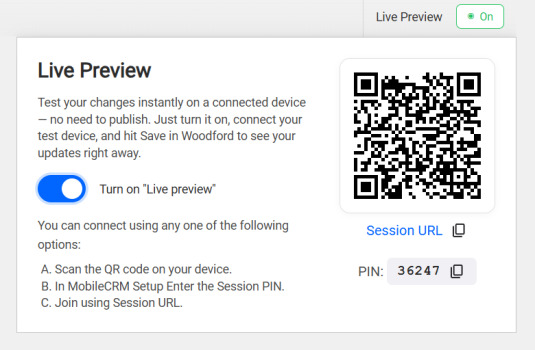
When designing an app project in Woodford, you often need to verify the changes in the app. Traditionally, this requires publishing the app project and then synchronizing the app. In this release, we're introducing live previews for forms and views. How does it work? In Woodford, click the new live preview button to display the connection information. In the app, scan the displayed QR code to establish a connection. While the live preview is active, any time you save a form or view, the change takes effect immediately in the connected app.
Currently, this functionality is considered experimental and supports automatic reloads for standard forms and lists. Modal forms and certain theme elements (such as standalone list captions) require manual refreshes in this version.
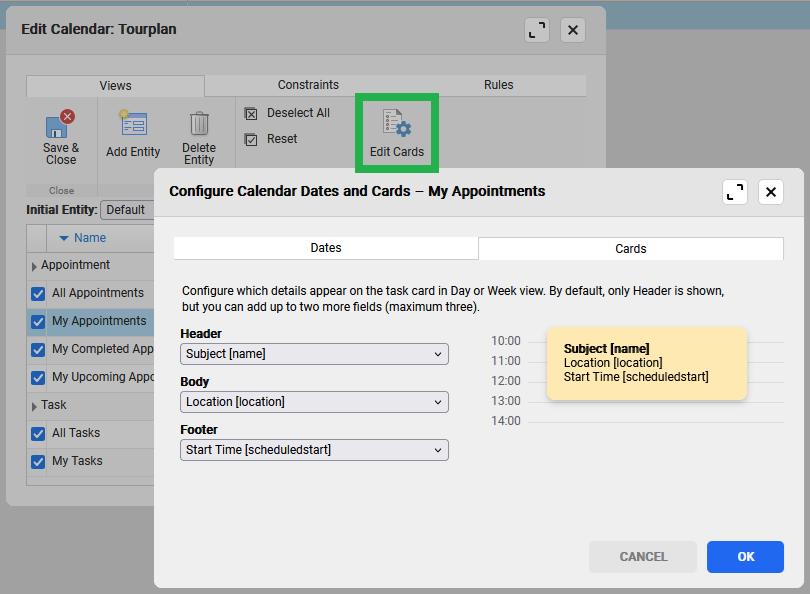
Customizable calendar cards
The calendar entries in Resco Mobile CRM can now display additional details about appointments. In the calendar configuration in Woodford, you can now define a card with up to 3 fields for each view available in the calendar.
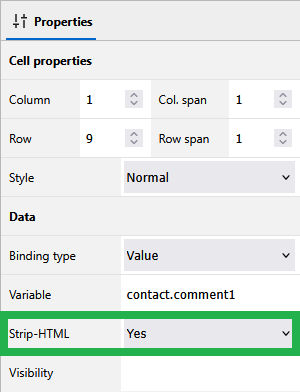
Rich text as plain text in reports
In Resco mobile reports, rich text fields used to render as is, i.e., including the HTML markup. Since this release, formatting tags can be removed when generating reports. Use the new text block property Strip-HTML to control the behavior.
Optimized image size in inspection reports
Reports generated from questionnaires with multi-image questions now use a different image format (JPG instead of PNG). As a result, the generated reports are significantly smaller in size while maintaining sufficient image quality.
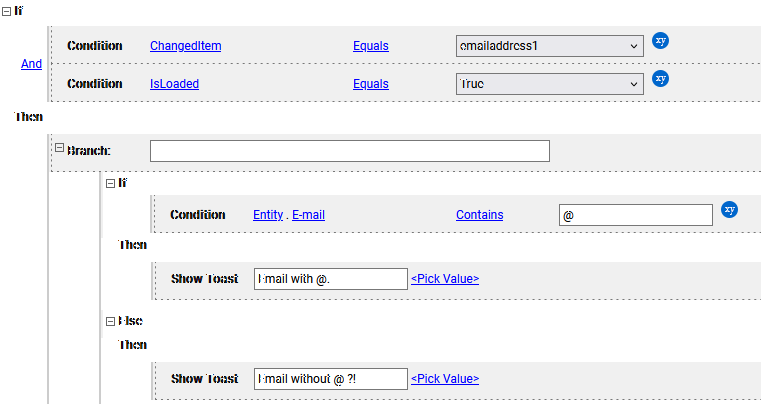
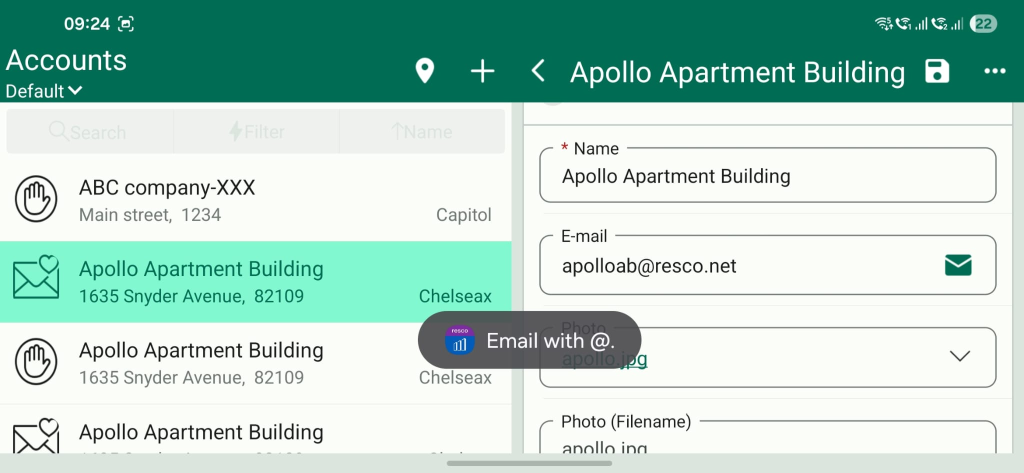
Rules: ShowToast
The new ShowToast function allows rule authors to display non-blocking toast notifications to users. Unlike the current Say Text function (which displays a modal window and requires the user to close it), ShowToast displays a brief, automatically disappearing notification, reducing unnecessary user interaction. This function is available for forms, in On Load, On Change, and On Save rules.
Simpler localization of commands
Woodford editors no longer have to memorize the exact string IDs (or check the wiki) to localize form commands. On the command management screen, select any command and click Change Localization. You can then directly change the translations of the selected command.
Preload iframes
On the Microsoft Store version of Resco Mobile CRM, loading forms with iframes is often slow. Initializing new Edge WebView2 containers can take a significant amount of time. We're introducing the option to optimize the process by preloading the container and reusing it for multiple iframes. The behavior is available for iframes on forms (with Visible = No), views, charts, calendar, and route plan.
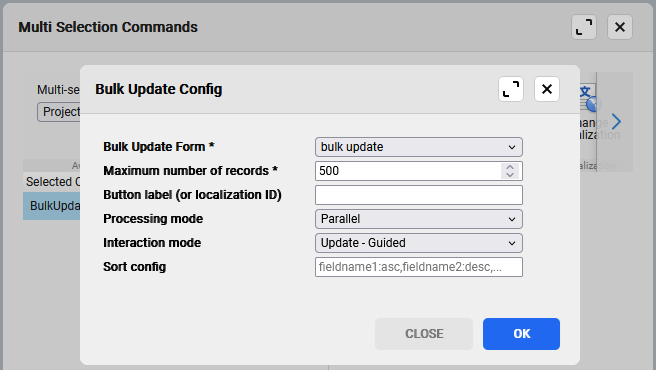
Bulk update enhancements
We are making bulk record updates much more powerful and flexible. If you haven't tried bulk updates before, now is a great time to add this feature to your projects.
-
You can define the order in which the records are processed.
-
By default, bulk updates run in parallel. You can now enable sequential processing for scenarios where execution order matters.
-
You can now choose between guided and silent modes: "Guided" requires user confirmation on every step, while "Silent" only prompt questions when errors or warnings occur.
-
In addition to the default "Update" mode for modifying records, we're introducing the "Action" mode for creating new records or performing other actions that don't modify existing records.
Automatic flashlight for barcode scanning
On Android and iOS, the app analyzes the ambient light conditions of the current camera feed in real-time and automatically enables the device flashlight is the environment is too dark. Once sufficient light is detected or the scan is complete, the flash turns off, requiring no user input.
CurrentUser fetch macro: Dynamic filtering of records from virtual tables
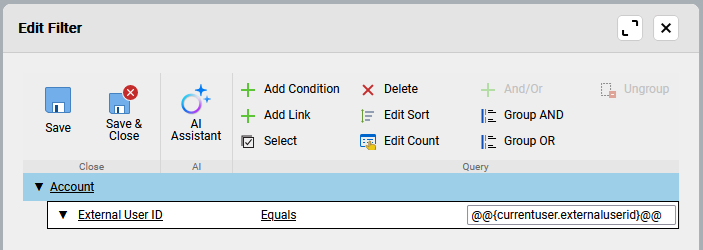
Since this release, a fetch macro @@{currentuser.columnname}@@ is available to build fetch conditions based on the values of fields on the systemuser record of the current user. This feature is only available for the Dynamics/Dataverse backend.
This can be useful in specific niche scenarios, such as building sync filters to return only records related to the current user on external (virtual) tables where there is no owner lookup column (e.g., integrations with Business Central, F&O, or SAP). In such cases, admins can define a custom externaluserid column on systemuser table, prefill the column with the user identifier from an external system, and use it in the sync filter like this:
<fetch>
  <entity name="account">
    <filter>
      <condition attribute="extid"
                 operator="eq"
                 value="@@{currentuser.externaluserid}@@" />
    </filter>
  </entity>
</fetch>
Max Sync Shared Records (Salesforce only)
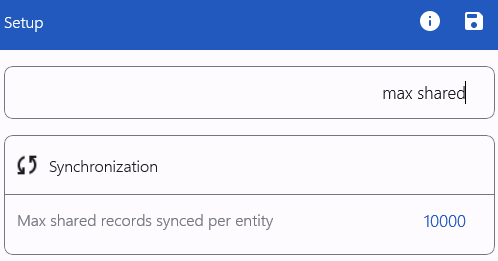
We're introducing a new setting to Woodford's app project Configuration: Max Sync Shared Records on the Offline Data Sync tab. This applies only to Salesforce. Similar to Max Sync Records, it sets a limit on the number of shared records that can be downloaded per entity. This limitation is imposed for performance reasons and to avoid excessive API consumption. Due to Salesforce API limitations, shared records are downloaded in batches of approximately 180 records, so downloading 10,000 records results in approximately 55 web requests. Only increase this number if sync longs contain a warning that the limit is reached and you are unable to decrease the number of shared records on the server side.
Note that users can also override this value in the mobile app via Setup: scroll to the Synchronization section and modify Max shared records synced per entity as needed.
Show/hide push notifications about completed sync
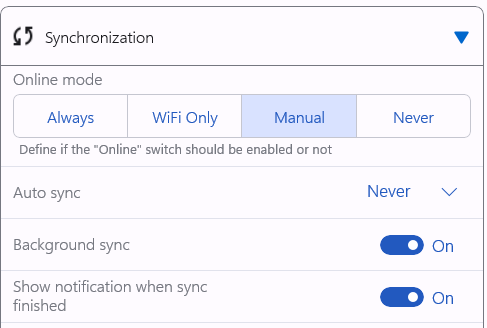
Woodford admins as well as users of Resco Mobile CRM can now decide if they want to see notifications about completed synchronizations. In Woodford project Configuration and in Resco Mobile CRM's Setup, use the new option Show notification when sync finished.
Before this change, the notification was always displayed, except on Windows devices. In general, we recommend keeping notifications enabled. However, in scenarios involving frequent background synchronizations, too many notifications can be disruptive.
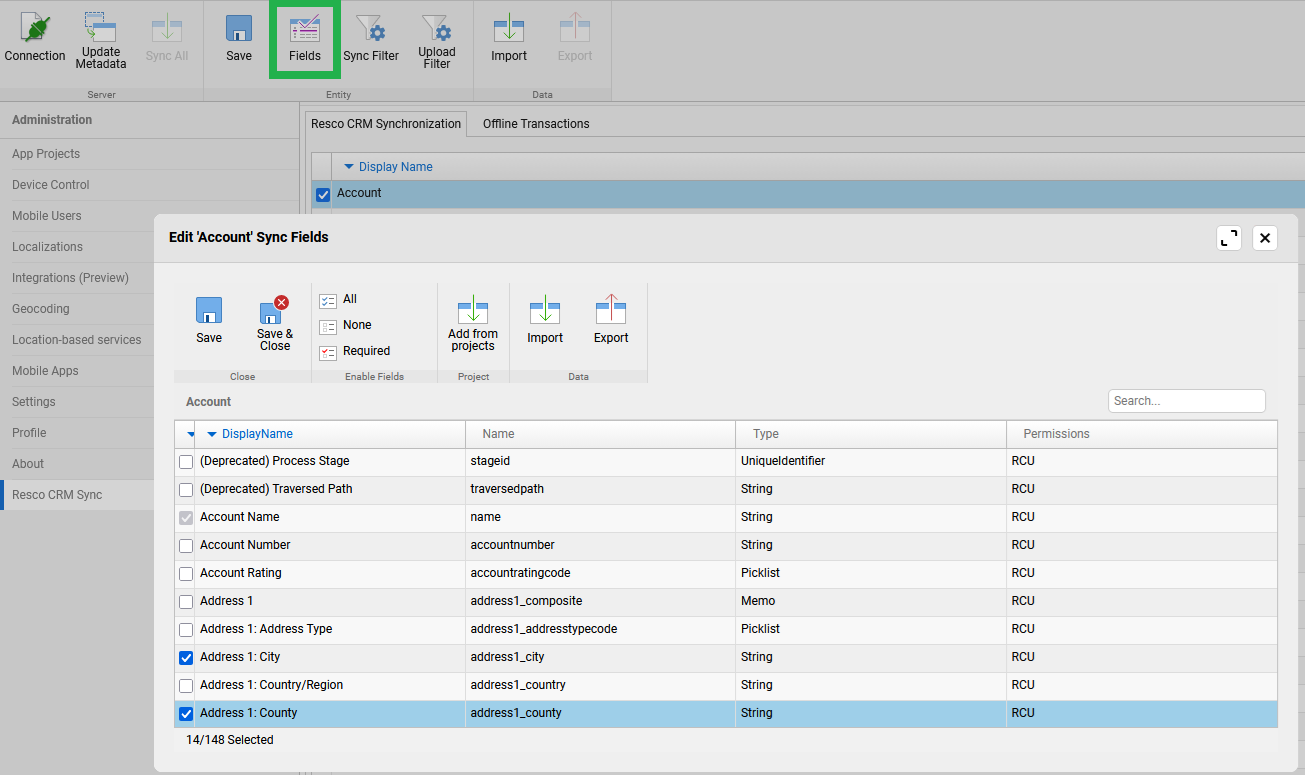
Resco CRM sync: customize columns
Resco CRM sync allows you to connect two organizations and exchange metadata and data. It is usually used in custom integration and migration scenarios.
The option to select which tables to synchronize already existed; one could also define the sync filter to identify a subset of records for syncing. In this release, your degree of control over synchronized data is improving again: you can define which columns (fields) should be synchronized for each table.